















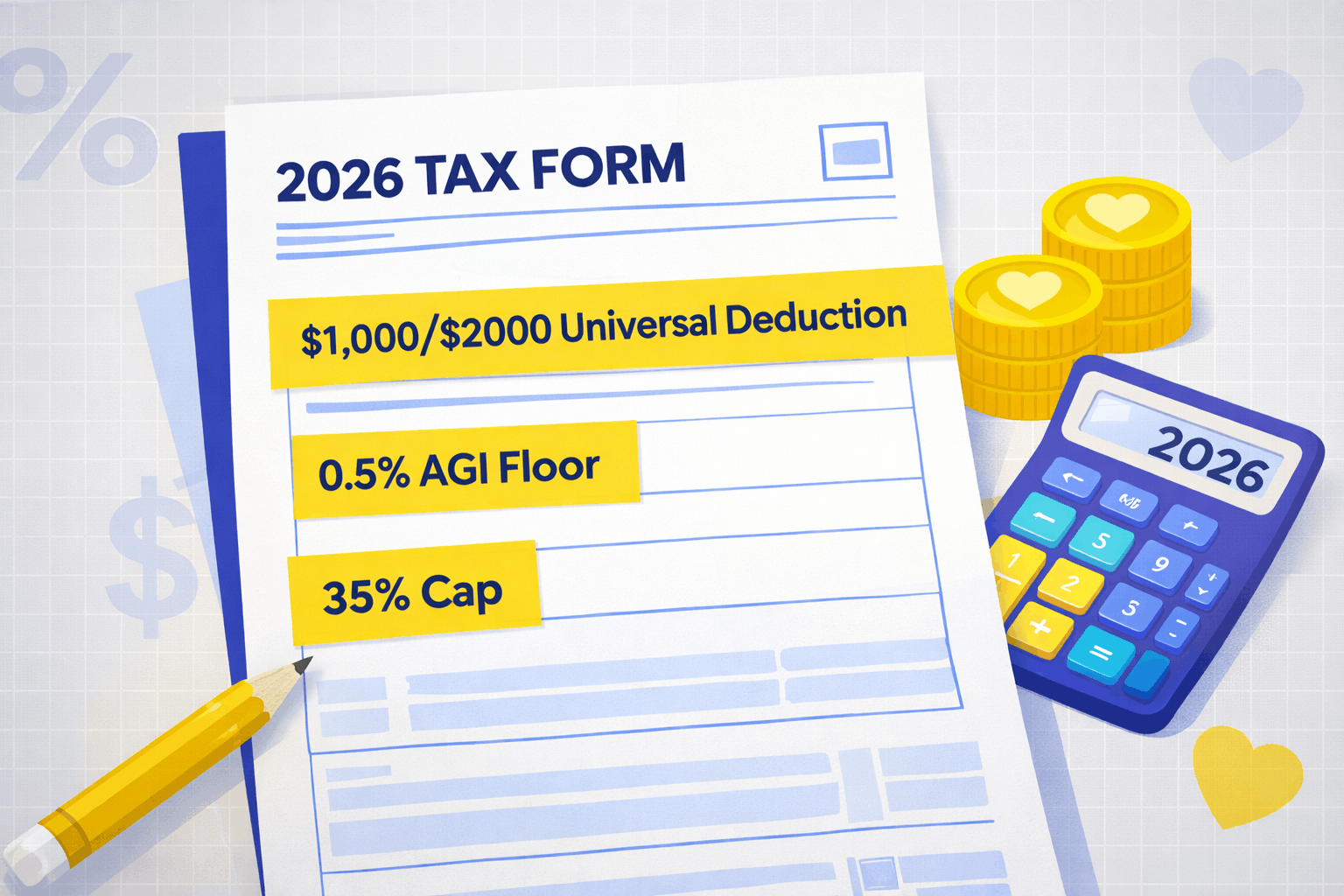
As of January 1, 2026, new charitable tax rules are shaping how donors plan their giving. The universal charitable deduction is now available to non-itemizers. A 0.5 percent AGI floor applies to itemizers. High-income taxpayers face new limits on the value of itemized deductions.
These changes directly affect how nonprofits should approach donor messaging, campaign timing, and digital fundraising strategy.
This article is for informational purposes only and does not constitute tax, legal, or financial advice. Donors should consult a qualified tax professional regarding their specific situation.
What Is the 2026 Universal Charitable Deduction?
The 2026 universal charitable deduction allows taxpayers who take the standard deduction to deduct up to $1,000 (single filers) or $2,000 (married filing jointly) in charitable contributions as an above-the-line deduction. This expands tax benefits to non-itemizers and increases participation incentives for middle-income donors.
The universal charitable deduction allows taxpayers who take the standard deduction to also deduct up to $1,000 for single filers and $2,000 for married couples filing jointly.
For years, donors who did not itemize received no incremental tax benefit for giving. That changes in 2026.
For nonprofits, this creates a simple messaging opportunity: donors can reduce taxable income even if they do not itemize.
How Does the 0.5% AGI Floor Affect Itemized Charitable Giving?
Starting in 2026, itemized charitable deductions are only deductible to the extent they exceed 0.5% of adjusted gross income (AGI). This small threshold incentivizes “bunching” strategies, where donors consolidate multiple years of giving into a single tax year to maximize deductibility.
For donors who itemize deductions, charitable contributions are deductible only after exceeding 0.5 percent of AGI.
This may shift behavior significantly. Many donors will bunch charitable donations rather than spreading them evenly year to year.
For nonprofits, 2026 may bring larger one-time gifts tied to tax timing.
How Do the 2026 Deduction Caps Affect Major Donors?
In 2026, high-income taxpayers face a 35% cap on the value of itemized deductions. While charitable giving remains deductible, the marginal tax benefit may be reduced for top earners, increasing interest in tax-efficient giving vehicles such as appreciated assets and donor-advised funds.
Major donors are unlikely to stop giving. However, they may reconsider how they structure gifts.
This is where digital fundraising infrastructure becomes critical.
Why Are 2026 Tax Changes Accelerating Digital Asset Giving?
Tax changes increase donor demand for efficient giving strategies. According to The Giving Block’s 2026 Annual Report on Crypto Philanthropy & Digital Fundraising Innovation, more than $100 million in cryptocurrency was donated in 2025, with an average crypto gift of $11,019. Stock giving rose 127% year over year, with average stock gifts of $51,250 .
When tax rules shift, donors evaluate efficiency.
Digital asset giving is scaling rapidly:
- Over $100 million in crypto donated in 2025
- Average crypto gift: $11,019
- Stock donation volume up 127% year over year
- Average stock gift: $51,250
As donors reassess tax strategy in 2026, nonprofits offering crypto, stock, and DAF giving directly on their websites will be positioned to capture larger gifts.
What Should Nonprofits Do in Response to the 2026 Charitable Tax Changes?
Nonprofits should update donation messaging to reflect the universal deduction, segment communications by donor type, and prominently feature crypto, stock, and DAF giving options. Frictionless digital asset acceptance will capture tax-planned gifts that might otherwise be delayed or redirected.
1. Update Donation Page Language
Reflect 2026 rules without offering personalized tax advice. Keep messaging simple and compliant.
2. Segment Donor Messaging
- Standard deduction donors → emphasize the $1,000/$2,000 universal deduction.
- Itemizers → discuss bunching strategies and multi-year impact.
3. Make Modern Giving Options Visible
Donors increasingly give from:
- Brokerage accounts
- Crypto wallets
- Donor-advised funds
Make these options clear and easy to use.
The Bottom Line
The universal charitable deduction, the 0.5 percent AGI floor, and the 35 percent deduction cap are reshaping charitable planning in 2026.
For nonprofits, this is not just a tax update. It is a fundraising strategy shift.
Organizations that educate clearly and invest in digital asset giving infrastructure will capture the next generation of tax-smart donors.
Ready to Future-Proof Your Fundraising for 2026?
The universal charitable deduction is now in effect. Donor planning behavior is shifting. Larger, tax-efficient gifts are increasingly flowing through digital channels.
Nonprofits that make crypto, stock, and DAF giving simple and visible, will be best positioned to win in 2026.
👉 Book a demo with The Giving Block and see what digital giving could look like for your organization.