
















- Donating appreciated cryptocurrency directly to a qualified 501(c)(3) may help eligible taxpayers avoid capital gains tax while potentially qualifying for a charitable deduction.
- Selling crypto before donating can trigger taxable capital gains that reduce the amount ultimately available for charitable giving.
- Bitcoin, Ethereum, Solana, stablecoins, and hundreds of other cryptocurrencies can be donated through The Giving Block.
- The Giving Block has now processed more than $300 million in crypto donations, including more than $100 million in 2025 alone, demonstrating the growing role of crypto in modern philanthropy.
Cryptocurrency has created significant wealth for millions of investors. Whether you’ve seen gains in Bitcoin, Ethereum, Solana, XRP, or another digital asset, many investors eventually face the same question:
How can I reduce my tax bill while making the biggest possible charitable impact?
For many U.S. taxpayers, donating appreciated cryptocurrency directly to a qualified nonprofit may be one of the most tax-efficient ways to give. Instead of selling your crypto and donating the remaining cash, you may be able to donate the asset itself. Depending on your individual tax situation, the IRS generally treats donations of appreciated cryptocurrency differently than cryptocurrency that is sold first. Depending on an individual’s circumstances, donating cryptocurrency directly to a qualified nonprofit may provide tax advantages. Donors should consult a qualified tax professional to understand how these rules apply to their situation.
Crypto Philanthropy has grown significantly in recent years as more investors choose to give digital assets instead of cash. Since launching in 2018, The Giving Block has facilitated more than $300 million in cryptocurrency donations, including over $100 million in 2025 alone. The average crypto donation reached $11,019 in 2025, demonstrating how digital assets have become an increasingly important source of charitable giving for nonprofits worldwide.
In this guide, you’ll learn how cryptocurrency is taxed, why donating crypto is often more tax-efficient than selling it first, and how to make a crypto donation that supports the causes you care about.
Note: The Giving Block is not a tax advisor and does not provide legal, financial, or tax advice. This article is for informational purposes only. Please consult a qualified tax professional regarding your individual financial situation.
Contents
- TL;DR: Donate Crypto, Lower Taxes
- How Cryptocurrency Gains Are Taxed
- Current Crypto Tax Rates
- Determining Your Cryptocurrency Taxes
- Reporting Your Crypto Holdings
- Minimizing Your Crypto Tax Burden
- The Tax Benefits of Donating Crypto
- Elevating Your Financial Strategy through Strategic Crypto Donations
TL;DR: Donate Crypto, Lower Taxes
Under current IRS guidance, donating appreciated cryptocurrency directly to a qualified nonprofit may offer tax advantages compared to selling the asset first and donating the proceeds.
Depending on your individual circumstances, donating cryptocurrency may:
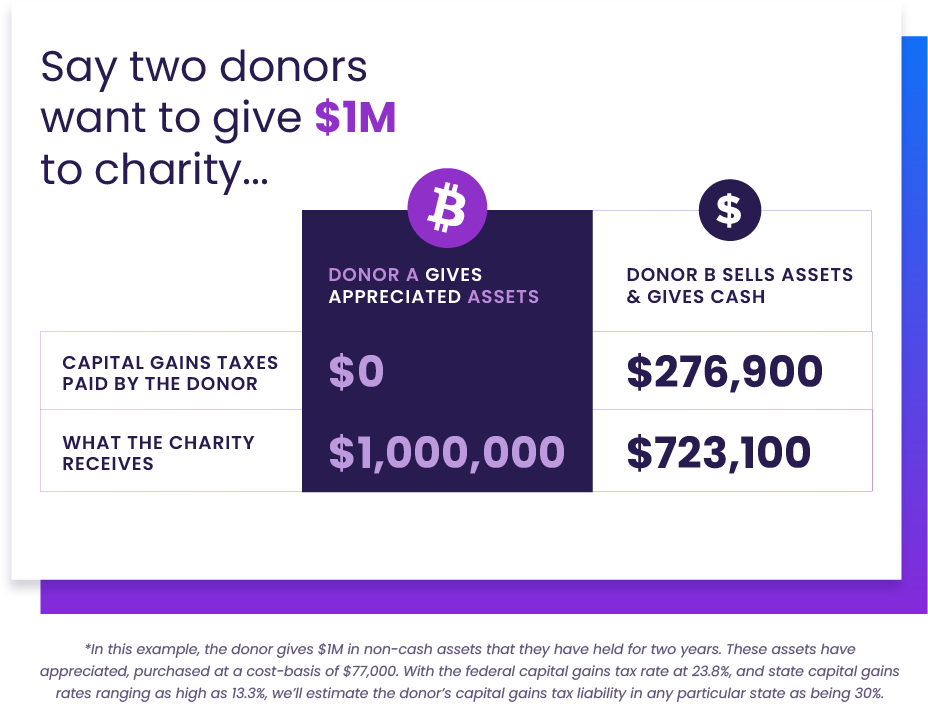
- Reduce or eliminate capital gains tax associated with selling appreciated cryptocurrency.
- Allow eligible donors to claim a charitable income tax deduction if they itemize deductions.
- Increase the value of the gift received by the nonprofit compared to donating after-tax cash proceeds.
Because tax treatment depends on each donor’s financial situation, it’s important to consult a qualified tax professional before making charitable giving decisions.
>> What do Vitalik Buterin, Gary Vee, and Yam Karkai have in common? They’re all honorees of our Faces of Crypto Philanthropy series.
How Cryptocurrency Gains Are Taxed
Despite its name, cryptocurrency is not treated like traditional currency for U.S. federal tax purposes.
Instead, the IRS treats cryptocurrency as property for federal tax purposes, similar to stocks, real estate, and other investment assets. As a result, selling, trading, or spending cryptocurrency may be considered a taxable transaction under current IRS guidance. Learn more in the IRS’s Virtual Currencies guidance.
Under current IRS guidance, the tax treatment of a cryptocurrency transaction generally depends on factors such as the original purchase price (known as your cost basis), the fair market value when the cryptocurrency is sold, traded, or spent, how long the asset was held, and the individual’s overall tax situation.
In general, if the value of a cryptocurrency has increased since it was acquired, disposing of the asset may result in a capital gain. If the value has decreased, disposing of the asset may result in a capital loss.
The applicable tax treatment generally depends on two primary factors:
- How long the cryptocurrency was held
- The taxpayer’s taxable income
In general, cryptocurrency held for more than one year may qualify for long-term capital gains tax treatment under current IRS rules.
Cryptocurrency held for one year or less is generally subject to the rules that apply to short-term capital gains.
It’s also important to remember that simply buying and holding cryptocurrency generally does not create a taxable event under current IRS guidance. Tax consequences may arise when cryptocurrency is sold, traded, spent, or otherwise disposed of.
The tax treatment of digital assets depends on an individual’s specific circumstances. For information about your situation, consult current IRS guidance or a qualified tax professional.
Current Crypto Tax Rates
Under current IRS guidance, the tax treatment of cryptocurrency generally depends on factors such as how long the asset was held and the taxpayer’s taxable income.
In general, cryptocurrency held for more than one year may qualify for long-term capital gains tax treatment under current federal tax rules.
Cryptocurrency held for one year or less is generally subject to the rules that apply to short-term capital gains.
The table below summarizes the current federal long-term capital gains tax rates.
2026 Long-Term Capital Gains Tax Rates (for filing in 2027)
| Tax-filing status | 0% tax rate | 15% tax rate | 20% tax rate |
| Single | $0 – $49,450 | $49,451 – $545,500 | Over $545,500 |
| Married, filing jointly | $0 – $98,900 | $98,901 – $613,700 | Over $613,700 |
| Married, filing separately | $0 – $49,450 | $49,451 – $306,850 | Over $306,850 |
| Head of household | $0 – $66,200 | $66,201 – $579,600 | Over $579,600 |
These are the current federal long-term capital gains tax rates. Depending on an individual’s circumstances, additional taxes, including the Net Investment Income Tax (NIIT) and applicable state taxes, may also apply.
Because tax laws change over time and every taxpayer’s situation is different, consult current IRS guidance or a qualified tax professional for advice specific to your circumstances.
Common Cryptocurrency Transactions
Under current IRS guidance, different types of cryptocurrency transactions may have different tax implications. Understanding how the IRS generally treats these transactions can help taxpayers maintain accurate records and prepare for tax season.
Because the tax treatment of digital assets depends on an individual’s specific circumstances, consult current IRS guidance or a qualified tax professional if you have questions about your situation.
Selling Cryptocurrency
Under current IRS guidance, selling cryptocurrency for U.S. dollars is generally considered a taxable transaction. The tax treatment depends on factors such as the cryptocurrency’s cost basis, holding period, fair market value at the time of the sale, and the taxpayer’s individual circumstances.
Trading One Cryptocurrency for Another
The IRS generally treats exchanging one cryptocurrency for another as a taxable transaction. Depending on the circumstances, the exchange may result in a capital gain or capital loss under current IRS rules.
Spending Cryptocurrency
Using cryptocurrency to purchase goods or services is generally treated as disposing of property under current IRS guidance. Depending on the individual’s circumstances, the transaction may have tax implications.
Mining Rewards
The IRS provides guidance on the tax treatment of cryptocurrency received through mining activities. Depending on the facts and circumstances, mining activity and the later sale or disposition of mined cryptocurrency may have different tax implications.
Staking Rewards
The IRS has also issued guidance on the tax treatment of certain staking rewards. Depending on the circumstances, receiving staking rewards and later selling or disposing of those assets may have different tax implications.
Airdrops and Hard Forks
The IRS has published guidance addressing cryptocurrency received through certain airdrops and hard forks. The tax treatment depends on the specific facts and circumstances surrounding the transaction.
Gifts and Inheritance
Under current IRS guidance, receiving cryptocurrency as a gift generally does not create an immediate taxable event. However, tax consequences may arise if the recipient later sells or otherwise disposes of the asset. Different rules may apply to inherited digital assets.
For additional information about digital asset taxation, visit the IRS’s Digital Assets page or consult a qualified tax professional.
>> Seeking Crypto Tax Advice or Assistance? Check out our Tax Resources for Crypto Investors.
Reporting Your Crypto Holdings
Keeping records of cryptocurrency transactions can become more complex over time, especially if you buy, sell, trade, stake, mine, or donate digital assets across multiple exchanges or wallets.
Maintaining organized records throughout the year can make it easier to understand your cryptocurrency activity when preparing your tax return or working with a qualified tax professional.
Keep Accurate Records
Maintaining detailed records can help document cryptocurrency activity and simplify tax reporting.
Records may include:
- The date of each transaction
- The type of transaction (purchase, sale, trade, donation, etc.)
- The cryptocurrency involved
- The amount of cryptocurrency
- The fair market value at the time of the transaction
- Any applicable transaction fees
Understand Reporting Requirements
The IRS provides guidance on reporting digital asset transactions, including reporting requirements and frequently asked questions.
Depending on an individual’s circumstances and the types of cryptocurrency transactions completed during the year, additional reporting requirements may apply.
For more information, visit the IRS Digital Assets page or consult a qualified tax professional.
Consider Crypto Tax Software
Many cryptocurrency users choose to use crypto tax software to help organize transaction history, calculate gains and losses, and prepare reports for tax filing.
Platforms such as Koinly allow users to import transactions from multiple exchanges and wallets and can also help organize cryptocurrency donations for recordkeeping purposes.
To learn more, read Koinly’s guide to crypto donation tax reporting.
Work With a Qualified Tax Professional
Cryptocurrency taxation continues to evolve as new guidance is issued and digital asset use cases expand.
If you have questions about how current IRS guidance applies to your specific situation, consider consulting a qualified tax professional with experience in digital assets.
Looking for additional educational resources? Visit The Giving Block’s Tax Resources to learn more about cryptocurrency donations, charitable giving, and year-end tax planning.
Why Some Donors Choose to Donate Cryptocurrency
Many cryptocurrency holders choose to donate appreciated digital assets directly to qualified nonprofits instead of selling them first.
For some donors, giving cryptocurrency is a convenient way to support the causes they care about while donating directly from their investment portfolio. Others appreciate the ability to give digital assets without first converting them to cash.
Under current IRS guidance, donating appreciated cryptocurrency may have different tax implications than selling cryptocurrency and donating the cash proceeds. Because every donor’s financial situation is unique, the potential tax treatment of a cryptocurrency donation depends on the individual’s circumstances.
Some donors choose to donate cryptocurrency for reasons such as:
- Supporting charitable causes they care about
- Donating appreciated digital assets directly to qualified nonprofits
- Potential tax advantages associated with charitable giving under current IRS guidance
- Helping nonprofits receive the full value of the donated cryptocurrency, rather than donating cash after selling the asset\
If you’re considering making a cryptocurrency donation, learn more about how crypto donations work or consult a qualified tax professional to understand how current IRS guidance may apply to your individual circumstances.
In crypto we get so many opportunities to succeed, sometimes overnight! It only seems right to spread those opportunities to causes that matter.
How Do You Enjoy The Tax Benefits of Donating Crypto?
Many cryptocurrency holders choose to donate appreciated digital assets instead of selling them first.
For example, imagine you purchased Bitcoin, Ethereum, or Solana several years ago and the value of your investment has increased over time. Depending on your individual circumstances, selling those assets may have different tax implications than donating them directly to a qualified nonprofit.
Under current IRS guidance, some donors choose to donate appreciated cryptocurrency directly because charitable donations of digital assets may be treated differently than cryptocurrency that is first sold for cash.
If you’re considering making a cryptocurrency donation, consult a qualified tax professional to understand how current IRS guidance applies to your situation.
Follow these steps to donate cryptocurrency to a qualified 501(c)(3) nonprofit through The Giving Block.

Whether you are estimating your gains and losses toward the end of the year, or just want to make a tax-efficient donation during the year, consider using your crypto to make a world of difference.
Estimate Your Potential Savings: Interested in estimating your potential tax savings? Try our Crypto Donation Tax Savings Calculator Tool for a personalized assessment.
Reduce Your Tax Burden With A Crypto Donation
Whether you’re planning a year-end gift or exploring new ways to support the causes you care about, The Giving Block makes it easy to donate cryptocurrency to thousands of qualified nonprofits.
If you’re considering a larger cryptocurrency donation or would like personalized support, learn more about Private Donor Services.
Ready to get started? Search thousands of charitable organizations and find a cause that matters to you.