














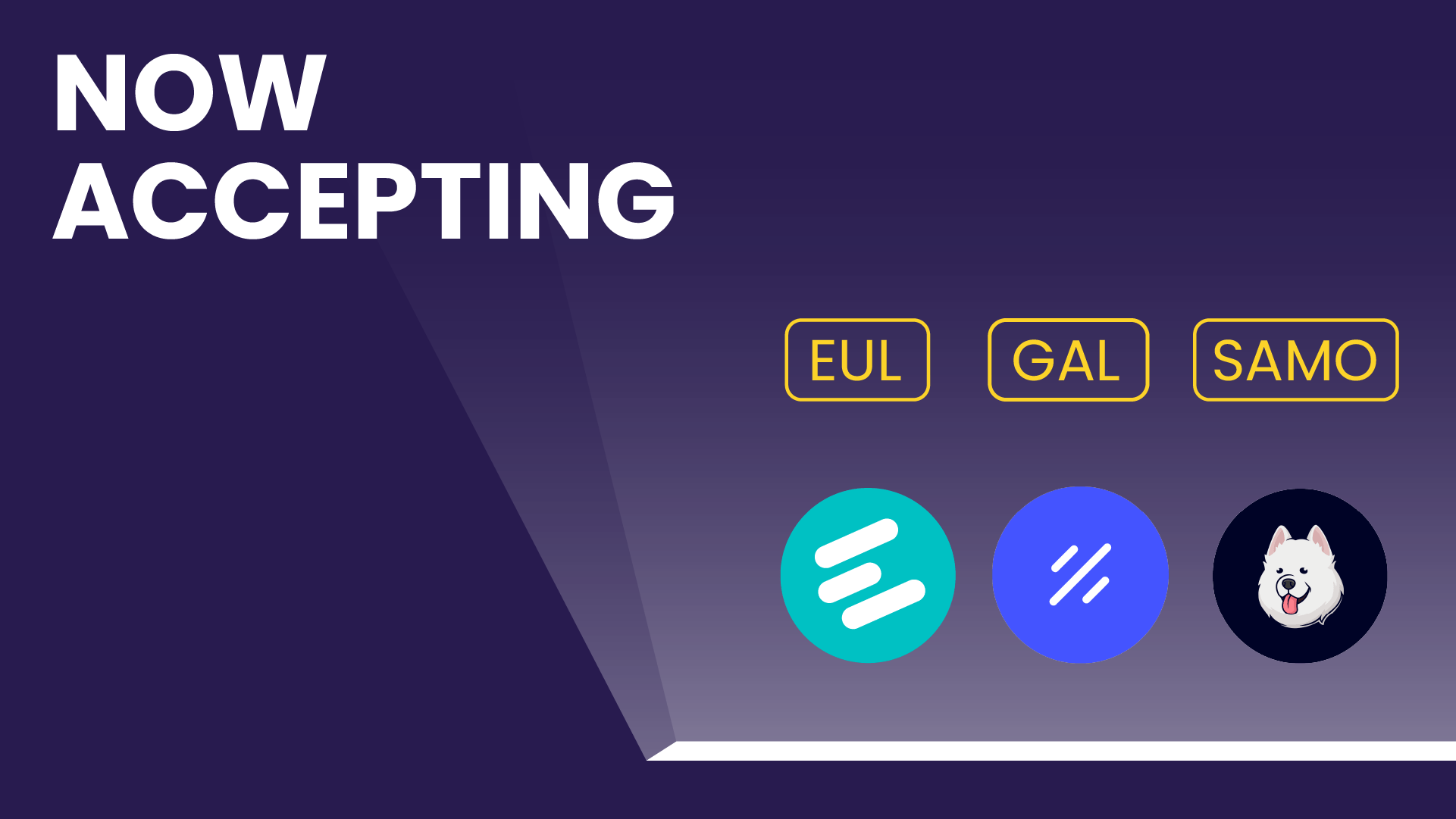
The Giving Block is excited to announce that we’re adding support for three more cryptocurrencies in our Donation Form and fundraising platform. Samoyedcoin (SAMO), Euler Finance (EUL) & Galxe (GAL) join a growing list of cryptocurrencies that nonprofits can accept with the fundraising tools and services powered by The Giving Block.

Samoyedcoin (SAMO)
Samoyedcoin (SAMO) began as a memecoin in 2021, akin to Dogecoin, but for the Solana network. More recently, the team has pivoted to focus on becoming “an experimental Web 3.0 community coin.” Using marketing strategies and a variety of other tactics, Samoyedcoin’s team currently helps educate and onboard people into the Solana community. Samoyedcoin’s active fanbase is called the Samo Famo.

Euler Finance (EUL)
Euler Finance makes it possible for users to lend and borrow cryptocurrencies. What makes Euler Finance different from other DeFi lending protocols such as Aave or Compound is its use of risk-based asset tiers designed to protect the protocol from risks typically associated with decentralized permissionless lending, especially with respect to illiquid or volatile assets.

Galxe (GAL)
Galxe aims to create an open, collaborative credential data network accessible to all developers in Web3. Use cases for Galxe include the creation of NFT loyalty programs, gated communities, and customized governance. Galxe can integrate on-chain as well as off-chain credentials like Discord and Twitter. Contributors to Galxe’s Credential Data Network are rewarded when credentials are utilized in Galxe’s Application Modules, Credential Oracle Engine, and Credential API.
We’re excited to be adding new cryptocurrencies because it gives donors more flexibility in the way they donate. We recognize that converting from one crypto to another can be a taxable event in many countries, so we want to offer flexibility to accept other tokens directly.
How to Donate SAMO, EUL & GAL to Charity
With this latest update, thousands of nonprofits, universities, faith-based and other mission-oriented organizations can now accept SAMO, EUL & GAL donations on The Giving Block Donation Form and platform.
Donors looking to support an organization or cause that’s important to them can do so by browsing nonprofits and Impact Index Funds and selecting Samoyedcoin, Euler Finance or Galxe in the Donation Form when completing the transaction.